While certainly the issues surrounding age as an issue in employment is no joking matter, every once in a while you hear a story that makes you smile anyway. The most recent for me came when I was referred to it by Gerry Crispin's post on his blog (The CareerXRoads Annex) which if you don't have it on your reading list would be an excellent one to add.
The post Gerry was blogging about was about a piece he saw in John Sumser's Electronic Recruiting News. Specifically, a piece that ran on the 22nd of May called The Hunt. As Gerry pointed out it isn't just that it is a really wonderfully well written piece, but one that brings a smile as well.
After I had read it, it reminded me of another "smile" story that my friend and world-class executive coach Bob Cuddy once told when he was talking about the age issue at one of our networking meetings some years ago.
He told us that the oldest client he had ever worked with was 92. So as it turns out, the guy gets an interview for a CFO opening with a manufacturing company in New Jersey. Bob gets him all tuned up for the interview and sends him off. Next day, Bob calls him to see how things went, and the client says "Well, I spent several hours there. Talked to the CEO, the VP of Operations, VP of R&D, Logistics, and VP of Sales & Marketing. So Bob, says, "Wow, that's great, what's next?" The client says "Well, they made me an offer, but I don't think I'm going to take it."
Bob, of course, was thunder struck and after explaining that getting interviews much less offers at age 92 is not an everyday occurrence, asked him why he thought he would turn it down. The client shot back "Well Bob, to be honest, after spending all the time I did with these guys and listening to what was going on there, I really am not sure how long they'll be around!"
Bob swears it is a true story. Knowing Bob, I don't doubt it for a minute.
Friday, May 26, 2006


Wednesday, May 24, 2006
Advice vs. Opinions
Everybody has pieces of their job that you like and look forward to. It helps to somewhat offset those pieces that drive you crazy and leaving you feeling like you could easily become a two or three martini poster child in very short order.
One of the pieces of my job that helps me to repress the martini merited events is when I have the chance to get out of the office and meet and talk with executives at one event or another. It's just plain fun for me, and more importantly, a great learning opportunity.
Last night it was an especially rewarding evening because I had been asked (by my colleague Bob Weber our VP of Enterprise Marketing) to not only be on a panel to talk to a joint meeting of the Wharton and Columbia Bschool clubs in our area, but because the other panelist was going to Judy Rosemarin, President and Founder of a NYC based company called Sense-Able Strategies.
I have been fortunate enough to have known and worked with Judy for 10+ years (I never can remember exactly how long) as she has served as the host and facilitator of our networking meetings in Manhattan. We have also been lucky enough to have her as the presenter of one of our most popular FastTrack programs which she calls: Winning Interviews: Converse, Connect, Convince. She has a passion for what she does, and among other aspects of her coaching practice, she loves getting her clients ready to be killer interview candidates. All of which is to say that having been an executive coach for more than 20 years, it isn't surprising that every time I listen to her, I learn something, and last night was no exception.
We were talking to the audience about the types of things that help people to become more effective at networking, and in particular what were some of the things that made people more comfortable and willing to help.
It was at this point that Judy suggested that one critical thing to do was to not ask people for "advise" but rather to seek their "opinion." It was one of those moments when you slap yourself on the forehead and say "why the hell couldn't I have thought of it that way?" It is such an important distinction, and as she went on to explain asking for advice creates pressure because there is an implicit risk of "what if my advice is wrong," whereas if you ask me for my opinion, the risk feels much, much less. Hell, as Judy said, "we all have opinions, and actually like to express them."
Every time I go to any event, or listen to any speaker, it is always my hope to walk away with a "take home." Something I can use in my job that will hopefully help to make me better at what I do. Judy does coaching for a living, I don't, but I do get "networked with" a fair amount, and while I have never objected to it, I vividly recall the discomfort I have felt as people would ask me for advice.
From here on out, I don't plan to offer as much advice as I will offer an opinion.
Thanks Judy.
One of the pieces of my job that helps me to repress the martini merited events is when I have the chance to get out of the office and meet and talk with executives at one event or another. It's just plain fun for me, and more importantly, a great learning opportunity.
Last night it was an especially rewarding evening because I had been asked (by my colleague Bob Weber our VP of Enterprise Marketing) to not only be on a panel to talk to a joint meeting of the Wharton and Columbia Bschool clubs in our area, but because the other panelist was going to Judy Rosemarin, President and Founder of a NYC based company called Sense-Able Strategies.
I have been fortunate enough to have known and worked with Judy for 10+ years (I never can remember exactly how long) as she has served as the host and facilitator of our networking meetings in Manhattan. We have also been lucky enough to have her as the presenter of one of our most popular FastTrack programs which she calls: Winning Interviews: Converse, Connect, Convince. She has a passion for what she does, and among other aspects of her coaching practice, she loves getting her clients ready to be killer interview candidates. All of which is to say that having been an executive coach for more than 20 years, it isn't surprising that every time I listen to her, I learn something, and last night was no exception.
We were talking to the audience about the types of things that help people to become more effective at networking, and in particular what were some of the things that made people more comfortable and willing to help.
It was at this point that Judy suggested that one critical thing to do was to not ask people for "advise" but rather to seek their "opinion." It was one of those moments when you slap yourself on the forehead and say "why the hell couldn't I have thought of it that way?" It is such an important distinction, and as she went on to explain asking for advice creates pressure because there is an implicit risk of "what if my advice is wrong," whereas if you ask me for my opinion, the risk feels much, much less. Hell, as Judy said, "we all have opinions, and actually like to express them."
Every time I go to any event, or listen to any speaker, it is always my hope to walk away with a "take home." Something I can use in my job that will hopefully help to make me better at what I do. Judy does coaching for a living, I don't, but I do get "networked with" a fair amount, and while I have never objected to it, I vividly recall the discomfort I have felt as people would ask me for advice.
From here on out, I don't plan to offer as much advice as I will offer an opinion.
Thanks Judy.
Wednesday, May 17, 2006
There Is No Such Thing As The Universal Solvent
I recently saw a study published by blog search engine Technorati taken in February that said that blogs were being created at a rate of
67.000 a day. Obviously, and even with modern conveniences like RSS feeds, etc., it is still impossible to keep up with what at times very much feels like a digital tsunami.
The bottom line is that one has to make choices, and one of the choices I made when it came to trying to stay tuned into the career management world was to make sure that I was on Pete Weddle's newsletter list. Anyone who follows the online recruiting space certainly knows who Pete is, and even if they don't, they still read what he has to say with great interest.
For our part, we spend a good deal of time trying to help our members, especially those who have not been active in the job market for a number of years, to come to understand what the real world of career management is really all about. In the age of point and click and when answering ads is simply a matter of turning on your PC or pressing send on your Treo, it is very easy to be seduced into a posture of simply sitting back and waiting for the world to come to you.
Leave it to Pete to help bring things back to earth, and the piece he did in his May 11th issue was just one more example of his ability to provide really worthwhile advice to anyone who has fallen into the trap of thinking that one's ROI in a job search is simply plug and play.
The article he wrote was entitled The 7 Bad Habits of Ineffective Job Seekers. As they say in the UK, it was "spot on."
Here is Pete's list:
Habit #1: Limiting the time and effort you invest in your job search
Habit #2: Limiting the research you do to plan your search campaign
Habit #3: Limiting your search to a handful of the same job boards
Habit #4: Limiting your application to clicking on the Submit button
Habit #5: Limiting your use of the Internet to reading job postings
Habit #6: Limiting the care you take with your communications
Habit #7: Limiting the preparation you do for employer interactions
To borrow a phrase, "the man knows whereof he speaks."
67.000 a day. Obviously, and even with modern conveniences like RSS feeds, etc., it is still impossible to keep up with what at times very much feels like a digital tsunami.
The bottom line is that one has to make choices, and one of the choices I made when it came to trying to stay tuned into the career management world was to make sure that I was on Pete Weddle's newsletter list. Anyone who follows the online recruiting space certainly knows who Pete is, and even if they don't, they still read what he has to say with great interest.
For our part, we spend a good deal of time trying to help our members, especially those who have not been active in the job market for a number of years, to come to understand what the real world of career management is really all about. In the age of point and click and when answering ads is simply a matter of turning on your PC or pressing send on your Treo, it is very easy to be seduced into a posture of simply sitting back and waiting for the world to come to you.
Leave it to Pete to help bring things back to earth, and the piece he did in his May 11th issue was just one more example of his ability to provide really worthwhile advice to anyone who has fallen into the trap of thinking that one's ROI in a job search is simply plug and play.
The article he wrote was entitled The 7 Bad Habits of Ineffective Job Seekers. As they say in the UK, it was "spot on."
Here is Pete's list:
Habit #1: Limiting the time and effort you invest in your job search
Habit #2: Limiting the research you do to plan your search campaign
Habit #3: Limiting your search to a handful of the same job boards
Habit #4: Limiting your application to clicking on the Submit button
Habit #5: Limiting your use of the Internet to reading job postings
Habit #6: Limiting the care you take with your communications
Habit #7: Limiting the preparation you do for employer interactions
To borrow a phrase, "the man knows whereof he speaks."
Saturday, May 13, 2006
With Friends Like That....
Ever wonder when it comes to referrals when you are in an "active" job search that your "A" list never seems to be the group from which the "link" really comes? I certainly have, and I am guessing so have a lot of others.
While I am not sure it is a definitive answer,while attending the annual conference for ACP in Boston a couple of weeks ago, I had the chance (and privilege I might add) to sit in on a presentation given by Larry Stybel, the Stybel in Stybel Peabody & Associates in Boston.
Larry is both an outstanding writer as well as speaker. The subject of his talk in Boston was based on an article he wrote in the MIT Sloan school management newsletter entitled "Friend, Foe, Ally, Adversary...or Something Else?" Very interesting stuff, and when I was listening to Larry explain to us the difference between friends, allies, adversaries and enemies I thought this would be a good thing to post in the blog, but my friend Sheryl Spainer whose blog I subscribe to posted something on the same subject and captured, as she always does, the essence of the message. So rather than reiterate what she has already stated so well, I would suggest if you are interested you just check out what she had to say. The blog post is called Enduring Allies.
If you are tired of hearing us at ExecuNet talk about networking that "isn't working" and were wondering why, you might want to take a few minutes and check out what Sheryl has to say. While we are banging the same drum, sometimes hearing it from someone else can help.
While I am not sure it is a definitive answer,while attending the annual conference for ACP in Boston a couple of weeks ago, I had the chance (and privilege I might add) to sit in on a presentation given by Larry Stybel, the Stybel in Stybel Peabody & Associates in Boston.
Larry is both an outstanding writer as well as speaker. The subject of his talk in Boston was based on an article he wrote in the MIT Sloan school management newsletter entitled "Friend, Foe, Ally, Adversary...or Something Else?" Very interesting stuff, and when I was listening to Larry explain to us the difference between friends, allies, adversaries and enemies I thought this would be a good thing to post in the blog, but my friend Sheryl Spainer whose blog I subscribe to posted something on the same subject and captured, as she always does, the essence of the message. So rather than reiterate what she has already stated so well, I would suggest if you are interested you just check out what she had to say. The blog post is called Enduring Allies.
If you are tired of hearing us at ExecuNet talk about networking that "isn't working" and were wondering why, you might want to take a few minutes and check out what Sheryl has to say. While we are banging the same drum, sometimes hearing it from someone else can help.
Monday, May 08, 2006
Talent Management vs. Career Management
A couple of weekends ago, I was in Boston attending the annual meeting of The Association of Career Management Professionals International - ACP for short. Great weather and great content quickly made me not to be upset over the fact that I was giving up a glorious spring weekend.
In any case, among the featured speakers was Dr. Edgar Schein, the well known and respected professor of management at MIT's Sloan school of management. The title of his talk was Discovering Your Real Values which was built around his many years of research on what he calls discovering one's career anchors. Fascinating stuff to those of us who follow this sort of thing, and hearing it from a source such as Dr. Schein, was an added treat.
What prompted me to say something about this experience here wasn't Dr. Schein's remarks per se but rather a phrase that he used during his presentation. The phrase was Talent Management versus Career Management. I am almost certain that he said the phrase did not originate with him, but in my notes, I guess I didn't write down where it came from, so for that and to the inventor I apologize.
I bring it up because the phrase, at least for me, was one of the most precise ways I have heard to describe the change in relationship of employer and employee. Indeed, it is a phrase that one could really say has applied to many, many years, not just recently. It is just that it may seem like it is new concept because up until 10 or 15 years ago, most of us kept telling ourselves that our employer was really "interested" in helping us to more effectively manage our careers, and while there have been and even are today, some companies that really are, by and large, they aren't.
What lots of us wanted to think of as company sponsored career management was really company sponsored talent management, and there's a significant difference as I am guessing anyone who has read this far already knows. Talent management is the WIFM for the employer. Career management is the WIFM for the employee. If they happen to match up from time to time, that's great, but make no mistake about where the interests lie for each.
I don't mean to say that this is necessarily bad. I really don't think it is. Indeed, with something that makes the delineation as clear as this phrase does, I think it can only help individual executives internalize and therefore hopefully act upon the notion that when it comes to your career, nobody cares about you more than you.
In any case, among the featured speakers was Dr. Edgar Schein, the well known and respected professor of management at MIT's Sloan school of management. The title of his talk was Discovering Your Real Values which was built around his many years of research on what he calls discovering one's career anchors. Fascinating stuff to those of us who follow this sort of thing, and hearing it from a source such as Dr. Schein, was an added treat.
What prompted me to say something about this experience here wasn't Dr. Schein's remarks per se but rather a phrase that he used during his presentation. The phrase was Talent Management versus Career Management. I am almost certain that he said the phrase did not originate with him, but in my notes, I guess I didn't write down where it came from, so for that and to the inventor I apologize.
I bring it up because the phrase, at least for me, was one of the most precise ways I have heard to describe the change in relationship of employer and employee. Indeed, it is a phrase that one could really say has applied to many, many years, not just recently. It is just that it may seem like it is new concept because up until 10 or 15 years ago, most of us kept telling ourselves that our employer was really "interested" in helping us to more effectively manage our careers, and while there have been and even are today, some companies that really are, by and large, they aren't.
What lots of us wanted to think of as company sponsored career management was really company sponsored talent management, and there's a significant difference as I am guessing anyone who has read this far already knows. Talent management is the WIFM for the employer. Career management is the WIFM for the employee. If they happen to match up from time to time, that's great, but make no mistake about where the interests lie for each.
I don't mean to say that this is necessarily bad. I really don't think it is. Indeed, with something that makes the delineation as clear as this phrase does, I think it can only help individual executives internalize and therefore hopefully act upon the notion that when it comes to your career, nobody cares about you more than you.
Tuesday, May 02, 2006
To Be Remembered & To Be Referred

Robyn Greenspan, the Sr. Editor one of our member newsletters, (CareerSmart Advisor) sent me some stats the other day on what was going on in the blogosphere. Pretty wild stuff:
Technorati now tracks over 35.3 Million blogs
- The blogosphere is doubling in size every 6 months
- It is now over 60 times bigger than it was 3 years ago
- On average, a new weblog is created every second of every day
- 19.4 million bloggers (55%) are still posting 3 months after their blogs are created
- Technorati tracks about 1.2 Million new blog posts each day, about 50,000 per hour
With numbers like the foregoing one wonders a lot of things, not the least of which is if all those people are blogging, who the heck is reading it all? Well, as we all know, the answer is a lot of people are, and there continues to be an on going debate about the impact of blogs on almost anything you can name, including one's career.
I came across a blog the other day called Scobleizer. It is authored by Robert Scoble who is a bit of a guru on the subject of blogging and has a book on it entitled: Naked Conversations: How Blogs are Changing the Way Businesses Talk with Customers.
Of particular interest to me, however, was the commentary going on relative to a posting he had on the site titled Blogging and Careers. By the time I got there, there were already some 17 comments covering a wide variety of flavors.
Even though they have been around for a while, I am not sure anyone is really totally sure if (a) blogs are here to stay, and if so, (b) what they will ultimately morph to.
What I do believe, however, is that when it comes to careers and the managing thereof, the use of telecommunications can be, as they say, a two-edged sword.
Indeed, my colleague Robyn actually has done a fair amount of research on the subject, and because "digital dirt" is becoming such an issue, even wrote a career guide for our members called Dealing With Your Digital Dirt.
On top of that, I got a call a couple of weeks ago from a producer at NBC Nightly News who wanted to talk me about the same subject as they were doing segment on the good, bad, and ugly of putting yourself out on the net be it MySpace, blogs, or whatever.
As the taping was winding down, the producer asked me if there was anything more I thought the audience should know about the impact of managing their careers when people are running around telling the world what they think about almost anything you want to name.
The response that came to my mind was not to try and argue the merits or demerits of "free speech" etc., but to remind people of two things:
1. The world operates on perception, and what you say and how you say it has an enormous impact on the perception they have or will have, and
2. If you are serious about managing your career, at any level, the name of the game is “To Be Remembered & To Be Referred,” and before you press the send button, keep in mind that you can be remembered for the wrong reasons as well as the right reasons.
Monday, April 24, 2006
Selling Experience
Last Tuesday's Journal had a piece entitled: Getting a Foot in the Door at 50-Plus. This article is only one of scores that I am sure we all have seen and continue to see, especially with all the hype around the boomers and their refusal to surrender in the War for Talent.
Given that the average age of ExecuNet's membership is 49, it is not at all surprising that we get lots and lots of questions and comments on the subject of age, age discrimination, age advantages, and lots in between. Since we have been around a while (18+ years) we also have been engaged in the dialogue on this subject for a fair amount of time as well. We also ask about it in our surveys, and in fact just recently did a "flash survey" which confirmed there was still some good news and bad news on the age front.
The good news was that while 63% of the respondents said that age discrimination is a serious problem in today's executive employment market, the percentage was down from the 77% in 2004 and the 82% that was the number in September of '03.
The fact that the percentage is down a fair amount I suspect is tied to both the economic cycle (the economy is lots better now than in '03) and the War for Talent demographics that may be starting to kick in.
I would also like to think that there is also a piece of this that speaks to the "education" of organizations who are discovering that if they don't take advantage of the experience offered by the over 50 cohort, they are shooting themselves in the foot on any number of levels.
Even if we can't ascribe some of this change to an epiphany on the part of employers, maybe it is just pragmatism coming from such factual realities that have been shared by such luminaries as Tom Peters who back in a presentation made at Radio City in September of '05 quoted some stats from David Wolfe and Robert Snyder's book Ageless Marketing which told us that the new customer majority was the age group of 44-65, and that this group was 45% bigger than the 18-43 segment and would be 60% bigger than that group by 2010.
Whatever the case, the facts seem to support two things:
1. Sad to say, age discrimination is alive and well, and
2. The revenge of the grey panthers, at least for the foreseeable future, may be taking shape.
Given that the average age of ExecuNet's membership is 49, it is not at all surprising that we get lots and lots of questions and comments on the subject of age, age discrimination, age advantages, and lots in between. Since we have been around a while (18+ years) we also have been engaged in the dialogue on this subject for a fair amount of time as well. We also ask about it in our surveys, and in fact just recently did a "flash survey" which confirmed there was still some good news and bad news on the age front.
The good news was that while 63% of the respondents said that age discrimination is a serious problem in today's executive employment market, the percentage was down from the 77% in 2004 and the 82% that was the number in September of '03.
The fact that the percentage is down a fair amount I suspect is tied to both the economic cycle (the economy is lots better now than in '03) and the War for Talent demographics that may be starting to kick in.
I would also like to think that there is also a piece of this that speaks to the "education" of organizations who are discovering that if they don't take advantage of the experience offered by the over 50 cohort, they are shooting themselves in the foot on any number of levels.
Even if we can't ascribe some of this change to an epiphany on the part of employers, maybe it is just pragmatism coming from such factual realities that have been shared by such luminaries as Tom Peters who back in a presentation made at Radio City in September of '05 quoted some stats from David Wolfe and Robert Snyder's book Ageless Marketing which told us that the new customer majority was the age group of 44-65, and that this group was 45% bigger than the 18-43 segment and would be 60% bigger than that group by 2010.
Whatever the case, the facts seem to support two things:
1. Sad to say, age discrimination is alive and well, and
2. The revenge of the grey panthers, at least for the foreseeable future, may be taking shape.
Sunday, April 16, 2006
The Difference Maker No Matter What
Guy Kawasaki as his bio says, "...is a managing director of Garage Technology Ventures, an early-stage venture capital firm and a columnist for Forbes.com. Previously, he was an Apple Fellow at Apple Computer, Inc. where he was one of the individuals responsible for the success of the Macintosh computer." He also has a very, at least to me, interesting blog where he writes about a lot of subjects, but a good deal about customer service.
One of the most recent pieces was called The Art of Customer Service. Guy has a list of 10 points any one of which could be posted in most companies and if followed would stand them in very good stead indeed. I thought it so powerful that I have made a copy to share with our team at our next staff meeting.
It may be an over-reaction on my part, and I know that it goes without saying that if your product or service is not competitive in the marketplace, outstanding customer service is irrelevant, but I truly do believe that all else being relatively equal, customer service is the largest difference you can make.
We live in an age where there is so much emphasis on automation, robotics, scanning, chips embedded in our pets (and our kids?) that it often seems like companies are doing all they can to separate themselves from the customer with an electronic wall. And don't get me wrong, I am all for technology as an enabler, but not as a substitute for customer care, both internally and externally.
Said differently, if you buy the argument that there isn't a heck of a lot of difference in most products or services which are priced roughly the same, then the one thing that can really separate one from the other is how they deal with their customers.
All of us as consumers know all too well what it feels like when customer service is poor. It makes you more than angry, it makes you feel violated and taken advantage of by people who could care less once the check has cleared or card charge has gone through.
Over the years, I have had a lot of people ask me how it is that the vast majority of our members still come to us by referral. My answer has always been the same, I think it's because we have always tried to make sure that we understand the difference between a member and a customer.
One of the most recent pieces was called The Art of Customer Service. Guy has a list of 10 points any one of which could be posted in most companies and if followed would stand them in very good stead indeed. I thought it so powerful that I have made a copy to share with our team at our next staff meeting.
It may be an over-reaction on my part, and I know that it goes without saying that if your product or service is not competitive in the marketplace, outstanding customer service is irrelevant, but I truly do believe that all else being relatively equal, customer service is the largest difference you can make.
We live in an age where there is so much emphasis on automation, robotics, scanning, chips embedded in our pets (and our kids?) that it often seems like companies are doing all they can to separate themselves from the customer with an electronic wall. And don't get me wrong, I am all for technology as an enabler, but not as a substitute for customer care, both internally and externally.
Said differently, if you buy the argument that there isn't a heck of a lot of difference in most products or services which are priced roughly the same, then the one thing that can really separate one from the other is how they deal with their customers.
All of us as consumers know all too well what it feels like when customer service is poor. It makes you more than angry, it makes you feel violated and taken advantage of by people who could care less once the check has cleared or card charge has gone through.
Over the years, I have had a lot of people ask me how it is that the vast majority of our members still come to us by referral. My answer has always been the same, I think it's because we have always tried to make sure that we understand the difference between a member and a customer.
Friday, April 14, 2006
Environment or DNA
Last week I was in Chicago attending a conference of folks who these days come under the heading of “human capital professionals.”
Like most conferences this one was filled with networking, power points and pontification. The speakers talked a lot about what we at ExecuNet have come to call “retention deficit disorder.” Companies who are worried that the generational demographics coupled with an economic rising tide will translate into a talent retention nightmare. Could well be. Our recently released 2006 Executive Job Market Intelligence Report says that more than 50% of executives are unhappy campers, and more than 75% plan to vote with their feet in then next six months.
So what’s the answer? Obviously the solution is made up of a lot of things, but to me, it still comes down to something pretty simple. Retention is about relationships. Hell, for that matter, and to state the obvious, life is about relationships. Good ones and bad ones.
I have also always felt that relationships, be they personal or business are fundamentally driven by the attitude that each party brings to it. Hardly an earth-shattering hypothesis. I don’t know if it’s DNA or environment, but my bias is that people, and therefore organizations, can be sorted into two groups. They are generally either “givers” or “takers.” While the “givers” are going to be taken advantage of from time to time (probably because they are too trusting) at the end of the day, it still reminds me of the wonderful Maya Angelou quote:
“People do not remember what you say or what you do, over the years, but they never forget how you made them feel.”
Like most conferences this one was filled with networking, power points and pontification. The speakers talked a lot about what we at ExecuNet have come to call “retention deficit disorder.” Companies who are worried that the generational demographics coupled with an economic rising tide will translate into a talent retention nightmare. Could well be. Our recently released 2006 Executive Job Market Intelligence Report says that more than 50% of executives are unhappy campers, and more than 75% plan to vote with their feet in then next six months.
So what’s the answer? Obviously the solution is made up of a lot of things, but to me, it still comes down to something pretty simple. Retention is about relationships. Hell, for that matter, and to state the obvious, life is about relationships. Good ones and bad ones.
I have also always felt that relationships, be they personal or business are fundamentally driven by the attitude that each party brings to it. Hardly an earth-shattering hypothesis. I don’t know if it’s DNA or environment, but my bias is that people, and therefore organizations, can be sorted into two groups. They are generally either “givers” or “takers.” While the “givers” are going to be taken advantage of from time to time (probably because they are too trusting) at the end of the day, it still reminds me of the wonderful Maya Angelou quote:
“People do not remember what you say or what you do, over the years, but they never forget how you made them feel.”
Wednesday, April 12, 2006
What Matters
It is always a good idea to get out of the office every now and again if for no other reason than to make sure that you don’t lose touch with the real world. I had the chance last week to do that in Chicago while attending the national human capital summit put on by one of our alliance partners, The Human Capital Institute.
It was a two-day affair, and I had the chance to not only listen and learn, but also ExecuNet had been asked to chair a panel the title of which was: The Executive Crisis: Grooming the Next Generation of Leaders.
As I reflected on my trip back to Connecticut, I was thinking that HCI might have just as easily used a conference tag line of the old standby: “the more things change, the more they stay the same.” While it is almost an embarrassment to admit that it has been nearly two decades since my work days were spent in corporate America, the issues under discussion by such luminaries as Wharton’s Peter Cappelli, or author Richard Florida (Flight of the Creative Class) or other well-known gurus such as Rich Karlgaard, author of Life 2.0 and publisher/columnist for Forbes, or leadership development icon Noel Tichy, gave me a Rod Serling sort of feeling.
The descriptors have changed. Now we call it “human capital” versus “human resources” or “personnel” or “employee relations”, but underneath it all, we were still trying to get our arms around the triad of employer needs, employee needs and life’s impact on both. Twenty years ago this was all more localized. We were just starting to wake up to the notion that there was a global economy. Now it is the case of dealing with all of it via cell phones, Blackberries, and wireless web access.
So what did I net out of the 2 days I spent trying to listen, learn, and where I could contribute to the discourse?
It’s always about leaders and our never-ending struggle to find them or develop them. In addition, it was also clear that the degree to which trust plays the key role in any relationship has a huge impact. Organizations who not only understand this but whose actions demonstrate their understanding daily are the ones who definitely have more than just a leg up in the race to Life 3.0 -- which is just over the horizon.
It was a two-day affair, and I had the chance to not only listen and learn, but also ExecuNet had been asked to chair a panel the title of which was: The Executive Crisis: Grooming the Next Generation of Leaders.
As I reflected on my trip back to Connecticut, I was thinking that HCI might have just as easily used a conference tag line of the old standby: “the more things change, the more they stay the same.” While it is almost an embarrassment to admit that it has been nearly two decades since my work days were spent in corporate America, the issues under discussion by such luminaries as Wharton’s Peter Cappelli, or author Richard Florida (Flight of the Creative Class) or other well-known gurus such as Rich Karlgaard, author of Life 2.0 and publisher/columnist for Forbes, or leadership development icon Noel Tichy, gave me a Rod Serling sort of feeling.
The descriptors have changed. Now we call it “human capital” versus “human resources” or “personnel” or “employee relations”, but underneath it all, we were still trying to get our arms around the triad of employer needs, employee needs and life’s impact on both. Twenty years ago this was all more localized. We were just starting to wake up to the notion that there was a global economy. Now it is the case of dealing with all of it via cell phones, Blackberries, and wireless web access.
So what did I net out of the 2 days I spent trying to listen, learn, and where I could contribute to the discourse?
It’s always about leaders and our never-ending struggle to find them or develop them. In addition, it was also clear that the degree to which trust plays the key role in any relationship has a huge impact. Organizations who not only understand this but whose actions demonstrate their understanding daily are the ones who definitely have more than just a leg up in the race to Life 3.0 -- which is just over the horizon.
Monday, April 03, 2006
The Find & Replace Feature
As I have mentioned here before, I try to stay tuned into the articles, discussions, and blogs that are all a part of the Electronic Recruiting Exchange. Because the postings are often thought-provoking, I'm a frequent visitor and the most recent piece by Lou Adler, CEO of The Adler Group called, Why We Lost The War For Talent got my attention.
In the article, he shares some figures from a survey he conducted along with some stats from a Gallup survey. The clear message from both surveys was that while companies recognize that finding good people was a major challenge (59% in the Gallup poll said that it was their "most pressing problem") very few of the companies that Lou polled (of which there were over 350 both big and small) said they felt good about how they were coping with the newest skirmishes in the war for talent.
This certainly squares with our own data. This was one of the many issues we recently addressed in our annual Executive Job Market Intelligence Report for 2006.
What somehow seems pretty weird at this "late date" is that while organizations say they are really concerned about dealing with a human capital marketplace that, absent any unforeseen events, (a sad commentary on the times in which we live) will continue to only get tighter, the number that are really trying to make it a top priority seems incredibly low, especially given the competitive risks at stake. How concerned? Over 80% of the recruiters we surveyed, which included both 3rd party and corporate, were clear in saying that they felt the war for talent was heating up and 79% agreed that there was a shortage of talent at the executive level.
Our survey of executive leadership came back with data that showed some 72% of the senior level executive respondents were planning to get out of Dodge within the next 6 months, and when it comes to filling the holes they will leave behind, we were seeing numbers like 75% of employed executives had turned down offers and so had 40% of the unemployed ones. There is a message in numbers like that and it isn't good for organizations that somehow haven't gotten around to reading the tea leaves surrounding retention of talent. This is one battle they can ill afford to lose.
Should be interesting to hear what others attending the Human Captital Institute's conference in Chicago next week have to say. We've been asked to head up a panel on this issue, which is titled: The Executive Crisis: Grooming the Next Generation of Leaders, and are looking forward to expressing at least one point of view and articulating some specific calls to action. The question before the house, of course, is not will be people listen, but rather will they act.
In the article, he shares some figures from a survey he conducted along with some stats from a Gallup survey. The clear message from both surveys was that while companies recognize that finding good people was a major challenge (59% in the Gallup poll said that it was their "most pressing problem") very few of the companies that Lou polled (of which there were over 350 both big and small) said they felt good about how they were coping with the newest skirmishes in the war for talent.
This certainly squares with our own data. This was one of the many issues we recently addressed in our annual Executive Job Market Intelligence Report for 2006.
What somehow seems pretty weird at this "late date" is that while organizations say they are really concerned about dealing with a human capital marketplace that, absent any unforeseen events, (a sad commentary on the times in which we live) will continue to only get tighter, the number that are really trying to make it a top priority seems incredibly low, especially given the competitive risks at stake. How concerned? Over 80% of the recruiters we surveyed, which included both 3rd party and corporate, were clear in saying that they felt the war for talent was heating up and 79% agreed that there was a shortage of talent at the executive level.
Our survey of executive leadership came back with data that showed some 72% of the senior level executive respondents were planning to get out of Dodge within the next 6 months, and when it comes to filling the holes they will leave behind, we were seeing numbers like 75% of employed executives had turned down offers and so had 40% of the unemployed ones. There is a message in numbers like that and it isn't good for organizations that somehow haven't gotten around to reading the tea leaves surrounding retention of talent. This is one battle they can ill afford to lose.
Should be interesting to hear what others attending the Human Captital Institute's conference in Chicago next week have to say. We've been asked to head up a panel on this issue, which is titled: The Executive Crisis: Grooming the Next Generation of Leaders, and are looking forward to expressing at least one point of view and articulating some specific calls to action. The question before the house, of course, is not will be people listen, but rather will they act.
Friday, March 31, 2006
Lessons from the Ethics Panel
One of the other sites I like and follow as best I can given the stresses of living in the 24/7 business world is the Electronic Recruiting Exchange where I find some pretty interesting discussions and blogs.
While the site is primarily designed for corporate and third party recruiters my interest in following the discussions is because to some degree we are part of the staffing space (one of the reasons we became a charter member of Pete Weddle's International Association of Employment Websites) and our membership is made up of both senior level executives (who have feelings and perceptions about the recruiting world) as well as recruiters - both corporate and third party (who have feelings and perceptions about candidates and clients).
That the ERE should be having discussions on the subject of ethics is no surprise. The recruiting industry has been talking about and around this subject for a long time, just as companies have been talking about it for a long time.
The most recent exchanges on this topic arose from a panel on ethics that was featured at ERE's recent conference in San Diego. One of the more recent posts on the subject was titled Lessons from the Ethics Panel if you wanted to check it out to see how the discussion was going. Clearly people have feelings on the subject, but it also makes one wonder why it should be a topic of discussion after all these years.
As I have followed the discussion and digested the points of view expressed, it reminded me of a couple of things:
1. Whether it is an individual, a group, a company, a profession, an industry, a country - we all (rightly or wrongly) have our reputations. Proof once again of the old saw: "Perceptions are real to those who hold them," and
2. "Actions speak louder than words."
While the site is primarily designed for corporate and third party recruiters my interest in following the discussions is because to some degree we are part of the staffing space (one of the reasons we became a charter member of Pete Weddle's International Association of Employment Websites) and our membership is made up of both senior level executives (who have feelings and perceptions about the recruiting world) as well as recruiters - both corporate and third party (who have feelings and perceptions about candidates and clients).
That the ERE should be having discussions on the subject of ethics is no surprise. The recruiting industry has been talking about and around this subject for a long time, just as companies have been talking about it for a long time.
The most recent exchanges on this topic arose from a panel on ethics that was featured at ERE's recent conference in San Diego. One of the more recent posts on the subject was titled Lessons from the Ethics Panel if you wanted to check it out to see how the discussion was going. Clearly people have feelings on the subject, but it also makes one wonder why it should be a topic of discussion after all these years.
As I have followed the discussion and digested the points of view expressed, it reminded me of a couple of things:
1. Whether it is an individual, a group, a company, a profession, an industry, a country - we all (rightly or wrongly) have our reputations. Proof once again of the old saw: "Perceptions are real to those who hold them," and
2. "Actions speak louder than words."
Wednesday, March 22, 2006
Careful What You Wish For
Robyn Greenspan, the Senior Editor of our Career Smart Advisor newsletter as well as the senior editor and writer of our Executive Job Market Intelligence Report that just went out to our members this week, has, among her many talents, a seemingly unique ability to find the quirky little tid bits here and there and then always has something thought provoking to say about it.
She sent me the following blurb that she found in the NY Times:
FINAL TAKE Some 21 percent of workers said they pitied their bosses, and 54 percent said they "could never be paid enough to take their boss's job," according to Money magazine, which also reports that the average chief executive's salary increased 14.5 percent in 2004, compared with a 3.7 percent raise for the average worker.
This lead the Times to comment:
"That leads to one of two possible conclusions. Either the boss deserves the money, or those who feel sorry for him may want to rethink their position."
Robyn's comment after she read it was: “Every company needs bench strength, so it’s probably a good idea that the 54 percent stay out of the way of the high-achieving 46 percent.” Love her sense of humor!
It also made me think a bit about the shots that bosses take. When I was growing up, the American dream was to rise up the corporate ladder and become a "boss." Sounded great until I got there. Once I got there, I found out in a hurry that it wasn't anything close to being "as advertised."
I also think that my experience in working with different bosses over time was probably not too different from my peers. I had a couple of really good ones, and some who were so bad that I kept saying to myself that they would get a separate chapter when I write my book.
Good or bad, however, I would like to think that I learned from each and as I continued on with what I now must look back on as a "career" it is my hope that I was able to save and apply the "good learnings" and drown the "bad learnings" in apple martinis.
She sent me the following blurb that she found in the NY Times:
FINAL TAKE Some 21 percent of workers said they pitied their bosses, and 54 percent said they "could never be paid enough to take their boss's job," according to Money magazine, which also reports that the average chief executive's salary increased 14.5 percent in 2004, compared with a 3.7 percent raise for the average worker.
This lead the Times to comment:
"That leads to one of two possible conclusions. Either the boss deserves the money, or those who feel sorry for him may want to rethink their position."
Robyn's comment after she read it was: “Every company needs bench strength, so it’s probably a good idea that the 54 percent stay out of the way of the high-achieving 46 percent.” Love her sense of humor!
It also made me think a bit about the shots that bosses take. When I was growing up, the American dream was to rise up the corporate ladder and become a "boss." Sounded great until I got there. Once I got there, I found out in a hurry that it wasn't anything close to being "as advertised."
I also think that my experience in working with different bosses over time was probably not too different from my peers. I had a couple of really good ones, and some who were so bad that I kept saying to myself that they would get a separate chapter when I write my book.
Good or bad, however, I would like to think that I learned from each and as I continued on with what I now must look back on as a "career" it is my hope that I was able to save and apply the "good learnings" and drown the "bad learnings" in apple martinis.
Monday, March 20, 2006
The Cost of March Madness
I think many of us saw the stats recently attributed to Challenger, Gray & Christmas on the cost of the lost productivity due to NCAA men's basketball tournament. Was a pretty impressive number, and makes one wonder how much more we "lose" when it comes to super bowl pools, fantasy football, baseball, NASCAR, and we hear there is even fantasy golf! It's a wonder anything gets done at all.
Anyway, in case you missed it, here is how Challenger et al got to their numbers:
- 58,548,000 = the number of Americans who are estimated to be fans of college basketball (41 percent of a workforce of 142.8 million).
- 13.5 minutes = the average amount of time U.S. workers are expected to spend on NCAA-related websites over the 16 business day tournament season.
- $4.05 = the average amount earned every 13.5 minutes by American workers
- $237,119,400 = the cost to employers nationwide in lost, unproductive wages for each 13.5 minutes of time wasted on the Internet.
- $3,793,910,400 or more = the total amount March Madness could cost employers over 16 business days of tournament.
Just for the fun of it, ExecuNet decided to take John C's formula, add a bit of data of our own, specifically compensation data of our membership based on our survey figures, along with occupational data from our friends at the Dept. of Labor. We came up with a number that says executives are responsible for $315,000,000 all by themselves.
If you have nothing else to do at half time, here's how we totaled it up:
- 943,000 = the number of executives who are estimated to be fans of college basketball (41 percent of the 2.3 million executive jobs in U.S., according to DoL).
- $20.88 = the average amount executives earn every 13.5 minutes (ExecuNet found that top executives, on average, earn $92.79 per hour).
- $19,689,847 = the cost to employers nationwide in lost, unproductive wages for each 13.5 minutes of time an executive wastes on the Internet.
- $315,037,440 or more = the total amount executive fans of March Madness could cost employers over 16 business days of tournament.
Not being a "numbers" guy, I didn't want to ask our team to go back and recalculate everything based on the fact that I stopped watching once two of my final four got knocked out by Sunday!
Anyway, in case you missed it, here is how Challenger et al got to their numbers:
- 58,548,000 = the number of Americans who are estimated to be fans of college basketball (41 percent of a workforce of 142.8 million).
- 13.5 minutes = the average amount of time U.S. workers are expected to spend on NCAA-related websites over the 16 business day tournament season.
- $4.05 = the average amount earned every 13.5 minutes by American workers
- $237,119,400 = the cost to employers nationwide in lost, unproductive wages for each 13.5 minutes of time wasted on the Internet.
- $3,793,910,400 or more = the total amount March Madness could cost employers over 16 business days of tournament.
Just for the fun of it, ExecuNet decided to take John C's formula, add a bit of data of our own, specifically compensation data of our membership based on our survey figures, along with occupational data from our friends at the Dept. of Labor. We came up with a number that says executives are responsible for $315,000,000 all by themselves.
If you have nothing else to do at half time, here's how we totaled it up:
- 943,000 = the number of executives who are estimated to be fans of college basketball (41 percent of the 2.3 million executive jobs in U.S., according to DoL).
- $20.88 = the average amount executives earn every 13.5 minutes (ExecuNet found that top executives, on average, earn $92.79 per hour).
- $19,689,847 = the cost to employers nationwide in lost, unproductive wages for each 13.5 minutes of time an executive wastes on the Internet.
- $315,037,440 or more = the total amount executive fans of March Madness could cost employers over 16 business days of tournament.
Not being a "numbers" guy, I didn't want to ask our team to go back and recalculate everything based on the fact that I stopped watching once two of my final four got knocked out by Sunday!
Saturday, March 18, 2006
The Wonders of Modern Telecommunications?
One of the e-newsletters I follow is The Herman Alert. It is published by Roger Herman and Joyce Gioia, and frequently has some interesting insights.
One of the more recent posts was titled Ubiquitous Cell Phones Blocking Relationships. Without going into great detail, the essence of the article was that the use of cell phones (and by implication other electronic communications) has gotten to the point where is was replacing personal relationships and in general going a long way to making the world far more impersonal not to mention impolite.
While people talking on cell phones in restaurants, on trains, and in other places where it really is pretty hard not to be annoyed by both the ringing and the conversations is certainly not anything I would endorse, I thought that this particular piece went a bit overboard in terms of sounding the death knell of modern society.
For example, one of the major complaints of the article was that we have people who work within a few yards of each other who communicate via email rather than getting from their desk and going to talk to someone in person.
On the surface I guess that may seem a bit odd, but frankly, it didn't strike me as that crazy. Maybe that's because we do so much of it here, but in doing so, and as I look around (and yes, even walk around) our office on a daily basis, I don't sense that the use of the technology is causing us to lose the personal relationships that we all value and feel are important.
Just because the technology is there doesn't mean that organizations can't do things to ensure that people stay connected on a personal level as well as an electronic one. In fact, I even believe that the electronic tools can help ensure that organizations "stay connected" and that the "connection" is even more personal, not less.
As an example, in our company, we have an email newsletter that goes to everyone in the company every working day. We use it to not just communicate "what's happening" that day on a business level, but often the "Buzz" as we call it, reports on personal achievements as well as contributions to the business. We have fun with it, and it is the technology that makes it possible.
In short, my feeling is that technology is an enabler of communication, both personal and professional, and not a replacement for personal relationships be they personal or professional.
The last time I looked, we manage the systems, the systems don't manage us. Bad manners are one thing, but organizations don't fail because of bad manners or technology that is "abused". They fail because they are not managed well. If things are too impersonal to the point where people don't care, it's because management doesn't care enough not because some jerk wants to show off his latest Bluetooth gadget.
One of the more recent posts was titled Ubiquitous Cell Phones Blocking Relationships. Without going into great detail, the essence of the article was that the use of cell phones (and by implication other electronic communications) has gotten to the point where is was replacing personal relationships and in general going a long way to making the world far more impersonal not to mention impolite.
While people talking on cell phones in restaurants, on trains, and in other places where it really is pretty hard not to be annoyed by both the ringing and the conversations is certainly not anything I would endorse, I thought that this particular piece went a bit overboard in terms of sounding the death knell of modern society.
For example, one of the major complaints of the article was that we have people who work within a few yards of each other who communicate via email rather than getting from their desk and going to talk to someone in person.
On the surface I guess that may seem a bit odd, but frankly, it didn't strike me as that crazy. Maybe that's because we do so much of it here, but in doing so, and as I look around (and yes, even walk around) our office on a daily basis, I don't sense that the use of the technology is causing us to lose the personal relationships that we all value and feel are important.
Just because the technology is there doesn't mean that organizations can't do things to ensure that people stay connected on a personal level as well as an electronic one. In fact, I even believe that the electronic tools can help ensure that organizations "stay connected" and that the "connection" is even more personal, not less.
As an example, in our company, we have an email newsletter that goes to everyone in the company every working day. We use it to not just communicate "what's happening" that day on a business level, but often the "Buzz" as we call it, reports on personal achievements as well as contributions to the business. We have fun with it, and it is the technology that makes it possible.
In short, my feeling is that technology is an enabler of communication, both personal and professional, and not a replacement for personal relationships be they personal or professional.
The last time I looked, we manage the systems, the systems don't manage us. Bad manners are one thing, but organizations don't fail because of bad manners or technology that is "abused". They fail because they are not managed well. If things are too impersonal to the point where people don't care, it's because management doesn't care enough not because some jerk wants to show off his latest Bluetooth gadget.
Monday, March 13, 2006
The Happenstance Theory of Career Planning
David Lawrence has a blog which he calls Ripples which I have followed for some time. He, in turn, follows a blog written by a fellow named Adrian Savage whose blog is titled: The Coyote Within. Had I stumbled across the title I would have taken a look just because I thought it was intriguing. He explains the title and his blog's purpose as follows:
"Coyotes are quick, smart and adaptable; everything a small business should be. And despite decades of persecution, they're still doing what they do best: being themselves.
A blog for sharing insights and thoughts into how to survive and prosper in a harsh world."
He has some interesting things to say about careers and how we do or don't manage them.
As I was reading through Adrian's most recent post and the suggestions he has for his readers (which made a lot of sense it seemed to me) it reminded me that I, like so many of my friends and colleagues, sit here some 40+ years into a "career" and realize that that while for the past 18 years I can say that I have never been more excited about what I am doing for a living, I also realize just how lucky I am to be able to say so, because the fact of the matter is that most of my career I had just let the "world happen to me." I was not proactive at all. Things happened, and I reacted as best I could. A sad commentary, but as life has gone on, I realize that I am far from alone in having managed my career in what I would now call "The Happenstance Theory of Career Planning."
As we all know, times change, and one generation observes and "learns" from another. In my generation, senior level executive jobs was the goal for a lot of us, even if we weren't quite sure why and didn't have any great strategy figured out on how we were going to get there.
In today's world, it feels to me like one of the key lessons learned by those who aspire to senior or executive level jobs is that if you are smart, you will not wait for the "world to happen to you." Indeed, given the type of turnover at the executive level that has surfaced since the early 90's, and if the make up of the membership here at ExecuNet is anything close to being representative today's executives are not sitting around waiting to react to events. The last time I looked at our membership mix, nearly 70% of the membership was made up of executives who were currently employed but who were keeping their both their eyes as well as their options open.
We also publish a comprehensive survey of the executive marketplace every year called the Executive Job Market Intelligence Report, and just one of the telling stats that surfaced this year was the fact that over half of the respondents described themselves as unhappy campers in their current jobs, but even more telling, over 70% said they planned to do something about it in the next six months.
While that doesn't give the nation's employers high marks in terms of figuring out how to retain the talent they have, it does indicate that executive level talent isn't just sitting around waiting for the world to happen to them anymore, and given the swing that we have seen in the market from buyers to sellers, there are going to be a lot of companies hurting for hires in the coming months.
"Coyotes are quick, smart and adaptable; everything a small business should be. And despite decades of persecution, they're still doing what they do best: being themselves.
A blog for sharing insights and thoughts into how to survive and prosper in a harsh world."
He has some interesting things to say about careers and how we do or don't manage them.
As I was reading through Adrian's most recent post and the suggestions he has for his readers (which made a lot of sense it seemed to me) it reminded me that I, like so many of my friends and colleagues, sit here some 40+ years into a "career" and realize that that while for the past 18 years I can say that I have never been more excited about what I am doing for a living, I also realize just how lucky I am to be able to say so, because the fact of the matter is that most of my career I had just let the "world happen to me." I was not proactive at all. Things happened, and I reacted as best I could. A sad commentary, but as life has gone on, I realize that I am far from alone in having managed my career in what I would now call "The Happenstance Theory of Career Planning."
As we all know, times change, and one generation observes and "learns" from another. In my generation, senior level executive jobs was the goal for a lot of us, even if we weren't quite sure why and didn't have any great strategy figured out on how we were going to get there.
In today's world, it feels to me like one of the key lessons learned by those who aspire to senior or executive level jobs is that if you are smart, you will not wait for the "world to happen to you." Indeed, given the type of turnover at the executive level that has surfaced since the early 90's, and if the make up of the membership here at ExecuNet is anything close to being representative today's executives are not sitting around waiting to react to events. The last time I looked at our membership mix, nearly 70% of the membership was made up of executives who were currently employed but who were keeping their both their eyes as well as their options open.
We also publish a comprehensive survey of the executive marketplace every year called the Executive Job Market Intelligence Report, and just one of the telling stats that surfaced this year was the fact that over half of the respondents described themselves as unhappy campers in their current jobs, but even more telling, over 70% said they planned to do something about it in the next six months.
While that doesn't give the nation's employers high marks in terms of figuring out how to retain the talent they have, it does indicate that executive level talent isn't just sitting around waiting for the world to happen to them anymore, and given the swing that we have seen in the market from buyers to sellers, there are going to be a lot of companies hurting for hires in the coming months.
Thursday, March 09, 2006
The Wisdom of the Flying Pig
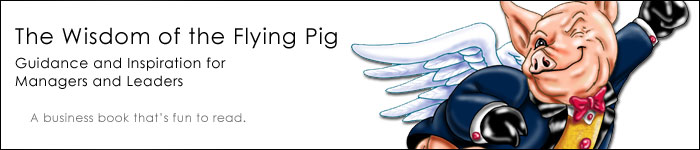
I have always wondered why I was such a sucker for those cool little books on managing that come out every once in a while. I am thinking of things like The One Minute Manager by Ken Blanchard and Spencer Johnson that was so popular some years back, as well as their more recent one, Who Moved My Cheese, or even Tom Peter's mega hit In Search of Excellence.
Prior to that, I used to look forward to getting these little gems published by Price Pritchett that were chuck full of quotes, affirmations, and pithy inspirational statements about "the right way to manage" in the 20th century. (Shows you how long ago that was!) They had great titles like Carpe Manana.
I still have them, and every now and again a break them out and sit there and nod my head wondering why it still rings so true and remains so hard.
I was reminded of all of this again when there arrived in the mail a cool looking, slick covered 103 page 5 x 8 book that was so slippery I had trouble turning the pages. In it was a note from its author, Jack Hayhow that read:
"Dave, Your post on 2/16, Building Retention the Old Fashioned Way, made me think you might enjoy the enclosed book."
The book was titled:The Wisdom of the Flying Pig, Guidance and Inspiration for Managers and Leaders.
How right he was.
Maybe I liked it so much because it seemed to be written for someone like me where patience is measured in nano seconds and any chapter that is more than 2 pages is a struggle. Maybe it is because it was full of lines like:
Reciprocity is a fundamental law of life and an indispensable lever for management effectiveness.
Managers don't get paid for what they do, they get paid for what their people do.
Conviction is worthless unless it is converted into conduct.
Using learnings from Drucker, Dr. Seuss and Cyndi Lauper, and a lot of folks in between, this little book, I thought, did in fact live up to what its author says was its intent on the back cover which simply stated is Word for word, we intend for this little book to the be most productive business reading you've ever done.
I don't know if is was the most productive business reading I've ever done, but nothing else comes to mind at the moment, and even if it wasn't, it's right up there.
I have spent lots more than $17.95 for business books, but I don't think any I have read in recent years provides a better ROI.
You can check it out at www.pigwisdom.com
Friday, March 03, 2006
Writing Checks is the Easy Part
I guess because of the business we're in that maybe we are a bit more sensitive than the average bear about noticing how different enterprises go about their business. When you have your own company, and therefore control over both your time and web real estate, it is interesting to see how different companies use both.
Peter Clayton, the Senior Producer and Director behind Landed Radio aka landed.fm is one of those folks who uses his time and real estate to do more than just promote his enterprise, and to that end, every now and again he shares one of these things he hears about (or is involved in on a personal level).
The most recent of these was a neat idea called Get In Their Shoes. The title by itself was enough of a teaser to get me to want to find out more. The short answer is that it is a concept started by the founders of the International Mentoring Network Organization, and Their Shoes Campaign is a call to action by successful business leaders, athletes, entertainers, and politicians to rally youth and aspiring leaders to lift themselves out of their limiting circumstances by proactively interviewing successful professionals within their own communities.
Aside from the fact that the whole concept struck me as pretty cool, I was also impressed that it involved people's personal time, not just having some sucessful folks write a check.
The fact that the individuals involved, and it's an impressive list, are giving of themselves is what will really have an impact on those they spend time with. My thanks to Peter for passing this along.
Peter Clayton, the Senior Producer and Director behind Landed Radio aka landed.fm is one of those folks who uses his time and real estate to do more than just promote his enterprise, and to that end, every now and again he shares one of these things he hears about (or is involved in on a personal level).
The most recent of these was a neat idea called Get In Their Shoes. The title by itself was enough of a teaser to get me to want to find out more. The short answer is that it is a concept started by the founders of the International Mentoring Network Organization, and Their Shoes Campaign is a call to action by successful business leaders, athletes, entertainers, and politicians to rally youth and aspiring leaders to lift themselves out of their limiting circumstances by proactively interviewing successful professionals within their own communities.
Aside from the fact that the whole concept struck me as pretty cool, I was also impressed that it involved people's personal time, not just having some sucessful folks write a check.
The fact that the individuals involved, and it's an impressive list, are giving of themselves is what will really have an impact on those they spend time with. My thanks to Peter for passing this along.
Monday, February 27, 2006
An Average Guy or Gal in Poughkeepsie
If Pete Weddle keeps writing about this stuff, I may have to just set up a separate space for commenting on his articles, as he has done it yet again in his Feb. 14 issue of his newsletter where the feature article was cleverly titled "An Average Guy or Gal in Poughkeepsie."
The piece caught my eye for a couple of reasons. First, Pete is a talented author, and secondly his insights and observations on the world of talent acquisition and retention are well worth the listen. I also noted that he had made reference to Tom Friedman's well-deserved best seller The World is Flat, and as soon as I saw that I knew it was something a wanted to read as well.
When I read about and hear about some of the things that continue to take place in companies in our country, I often go to sleep wondering if they are on the same planet as the rest of us. A lot of the time, it feels like a case of collective denial. Indeed, one would think that by now, we would understand that we are indeed competing in a true global market place and therefore be acting with the level of urgency that this reality suggests and which Friedman has so powerfully presented, not just in "Flat" but in his book "The Lexus and the Olive Tree" as well, not to mention the running commentary in his columns from time to time.
What I liked about Pete's take on all this was the pragmatism he suggests for the world in which we live, and how dealing with that reality should play out in someone who is looking to manage his/her own career. His message is very clear. If we, as a nation, want to maintain our leadership, and most especially economically, then we need to "out perform" the competition. How right he is.
It seems to me that one of the greatest strengths we have is our competitive spirit, and when it is your standard of living that you stand to lose, one would think that it shouldn't take too much more than understanding that to get your juices flowing, but when one sees what is going on at companies like GM, who seem to be the current poster child for just starting to "wake up" it gets a little scary.
Pete closed out his piece by saying "...the only way to endure in this new World of work is to win, and the only way to win is to be better than the other guy or gal wherever they may live." Winners, if they really want to be world beaters, usually need "coaches." In business we tend to call them supervisors, department heads, functional heads, division heads, SBU heads, SVPs, EVPs, COOs and CEOs and a lot in between. The common term and label is "leader."
At ExecuNet, we have done a survey of the recruiting community for the past 14 years, and one of the questions we have always asked is what are the key characteristics your clients ask you to find. The top answer, every single year has been "leadership.
All you have to be is be a casual observer of the world market place and read books like Friedman's or read pieces such as Pete has done to know that we'd better get on the stick.
The piece caught my eye for a couple of reasons. First, Pete is a talented author, and secondly his insights and observations on the world of talent acquisition and retention are well worth the listen. I also noted that he had made reference to Tom Friedman's well-deserved best seller The World is Flat, and as soon as I saw that I knew it was something a wanted to read as well.
When I read about and hear about some of the things that continue to take place in companies in our country, I often go to sleep wondering if they are on the same planet as the rest of us. A lot of the time, it feels like a case of collective denial. Indeed, one would think that by now, we would understand that we are indeed competing in a true global market place and therefore be acting with the level of urgency that this reality suggests and which Friedman has so powerfully presented, not just in "Flat" but in his book "The Lexus and the Olive Tree" as well, not to mention the running commentary in his columns from time to time.
What I liked about Pete's take on all this was the pragmatism he suggests for the world in which we live, and how dealing with that reality should play out in someone who is looking to manage his/her own career. His message is very clear. If we, as a nation, want to maintain our leadership, and most especially economically, then we need to "out perform" the competition. How right he is.
It seems to me that one of the greatest strengths we have is our competitive spirit, and when it is your standard of living that you stand to lose, one would think that it shouldn't take too much more than understanding that to get your juices flowing, but when one sees what is going on at companies like GM, who seem to be the current poster child for just starting to "wake up" it gets a little scary.
Pete closed out his piece by saying "...the only way to endure in this new World of work is to win, and the only way to win is to be better than the other guy or gal wherever they may live." Winners, if they really want to be world beaters, usually need "coaches." In business we tend to call them supervisors, department heads, functional heads, division heads, SBU heads, SVPs, EVPs, COOs and CEOs and a lot in between. The common term and label is "leader."
At ExecuNet, we have done a survey of the recruiting community for the past 14 years, and one of the questions we have always asked is what are the key characteristics your clients ask you to find. The top answer, every single year has been "leadership.
All you have to be is be a casual observer of the world market place and read books like Friedman's or read pieces such as Pete has done to know that we'd better get on the stick.
Thursday, February 16, 2006
Building Retention The Old Fashioned Way
There was a commercial that ran on TV many years ago for one of the brokerage houses where the tag line went something like "We make money the old fashioned way, one investor at a time."
I was reminded of this line when reading The Herman Group's newsletter called The Herman Trend Alert. It is written by Roger Herman and Joyce Gioia whose consulting firm does a good deal of "futurist" visions about the world of work.
The one that arrived this past week was, like so much of what crosses our collective desks these days, focused on retention. It was titled "Focus on the Individual." It is a good read, and in it, they talk about some of the ways in which they feel that focus on the individual will play out in the years ahead. For example, job descriptions will be replaced by "individualized expectation statements." Performance management will get translated more into "linking individual expectations to individual results." Interesting stuff to think about.
As I was reading all this, it also got me to thinking about the managers I have had myself, as well as those I have observed over the years. It took me about a nano second to say to myself, I have known managers who did indeed manage by the individual not by the numbers. I have also known managers who, it seemed to me, not only didn't know how to spell individual, and if they could recognize an individual, the only one that they could relate to was themselves.
I know that retention is the buzz word of the week. I sometimes wonder when or if retention will turn out to be the most used keyword on Google at some point. I guess that's when you know it has really become a "trend."
In any case, my point is that as I think about retention as an issue, it made be think about the tag line "...one investor at a time." The successful managers I have known, the ones I looked up to, the ones I wanted to emulate, were those who treated me like an individual. They listened to me, they helped point out to me those areas where I could improve. They made sure I knew when I had done something right and showed understanding when I did something wrong. I knew they cared about me as a person and a professional even though I didn't always agree with the decisions made.
There is another old saying that goes: "People don't leave companies, they leave managers." An over simplification perhaps, but it my experience, more right than wrong. Sometimes managers are a reflection of the culture, or if not a reflection per se, their behavior is a reflection of how the organization rewards behavior.
If organizations are really serious about retention, then they will start rewarding the behaviors that promote it.
I was reminded of this line when reading The Herman Group's newsletter called The Herman Trend Alert. It is written by Roger Herman and Joyce Gioia whose consulting firm does a good deal of "futurist" visions about the world of work.
The one that arrived this past week was, like so much of what crosses our collective desks these days, focused on retention. It was titled "Focus on the Individual." It is a good read, and in it, they talk about some of the ways in which they feel that focus on the individual will play out in the years ahead. For example, job descriptions will be replaced by "individualized expectation statements." Performance management will get translated more into "linking individual expectations to individual results." Interesting stuff to think about.
As I was reading all this, it also got me to thinking about the managers I have had myself, as well as those I have observed over the years. It took me about a nano second to say to myself, I have known managers who did indeed manage by the individual not by the numbers. I have also known managers who, it seemed to me, not only didn't know how to spell individual, and if they could recognize an individual, the only one that they could relate to was themselves.
I know that retention is the buzz word of the week. I sometimes wonder when or if retention will turn out to be the most used keyword on Google at some point. I guess that's when you know it has really become a "trend."
In any case, my point is that as I think about retention as an issue, it made be think about the tag line "...one investor at a time." The successful managers I have known, the ones I looked up to, the ones I wanted to emulate, were those who treated me like an individual. They listened to me, they helped point out to me those areas where I could improve. They made sure I knew when I had done something right and showed understanding when I did something wrong. I knew they cared about me as a person and a professional even though I didn't always agree with the decisions made.
There is another old saying that goes: "People don't leave companies, they leave managers." An over simplification perhaps, but it my experience, more right than wrong. Sometimes managers are a reflection of the culture, or if not a reflection per se, their behavior is a reflection of how the organization rewards behavior.
If organizations are really serious about retention, then they will start rewarding the behaviors that promote it.
Subscribe to:
Posts (Atom)